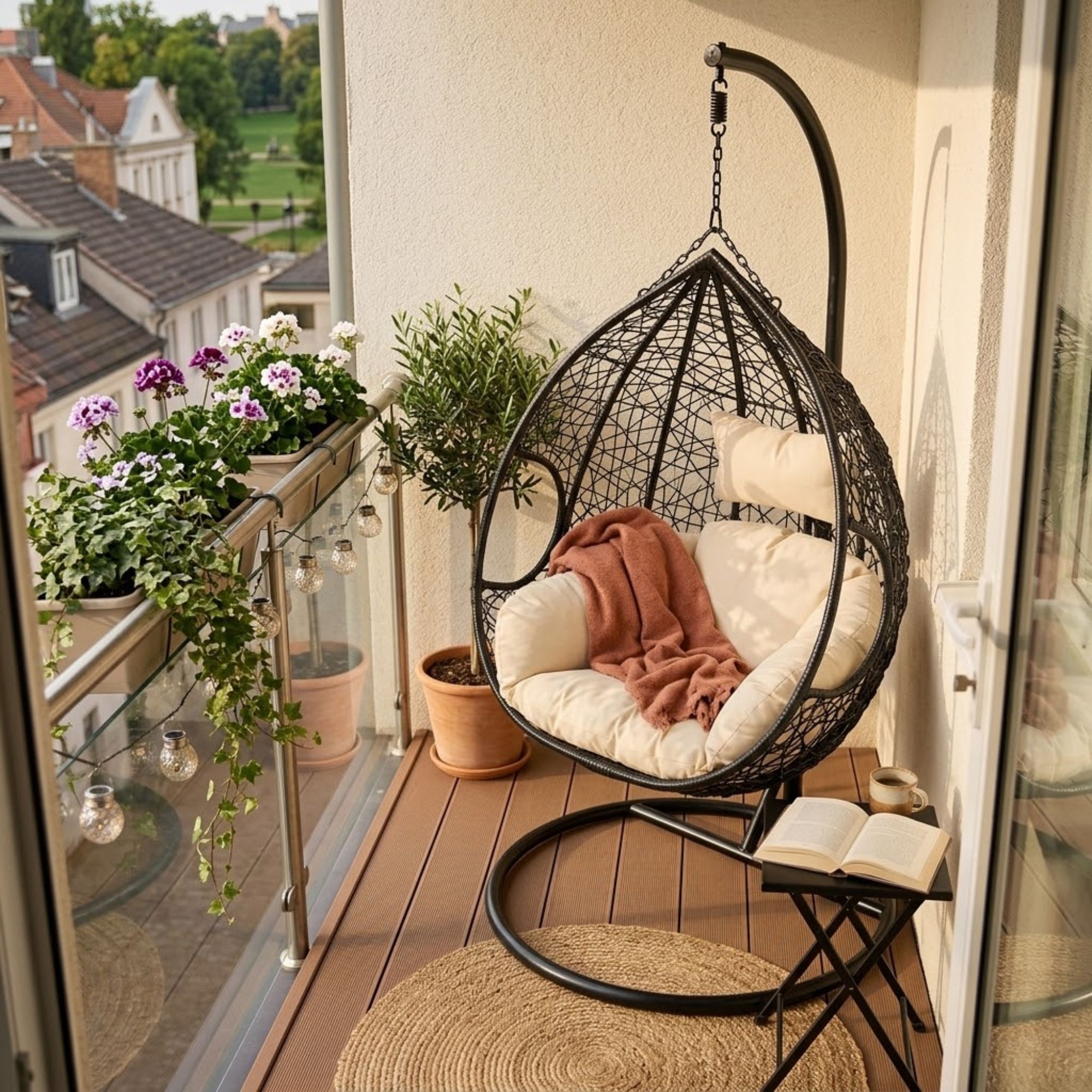
In the case of a small balcony, precise measurements are an absolute foundation. It is not enough to be guided solely by the width of the basket itself, because the key parameter is the diameter of the frame base, which in practice takes up the most space on the floor. Standard models have bases with a diameter of 95 to 105 cm, which for a balcony with a width of about 110 cm means very limited maneuvering space, and often even a complete blockage of the passage.
Therefore, before purchasing, it is worth carefully "drawing out" the layout of the chair, even symbolically, e.g., using masking tape on the floor. This will allow you to better imagine how much space the chair will actually take up and whether a comfortable communication path will remain.
It is also extremely important to take into account the so-called swinging zone. A hanging chair does not stay in one position but works gently during use, so it needs additional space. It is assumed that the minimum is about 20 cm of clearance at the back and sides, but in practice, the more slack, the higher the comfort of use. Otherwise, the chair may rub against walls, railings, or glass, which not only reduces comfort but also affects safety.
It is also worth paying attention to the height of the balcony. Some models are taller, especially those with a more elaborate frame, so you should make sure that the structure will fit under the ceiling or the loggia roof.
Another aspect is the quality of workmanship. Solid frames made of powder-coated steel are characterized by high resistance to corrosion and mechanical damage. A standard load capacity of up to 120 kg ensures safe use, and a properly profiled base guarantees stability. The appropriate thickness of the profiles is an additional guarantee of durability; such a structure does not deform and retains its properties for a long time.
The selection of the appropriate model should depend not only on aesthetics but primarily on the technical conditions of the balcony and your installation capabilities.
A cocoon on a stand is a universal solution and very convenient for daily use. It works best in corners or niches where its base can be "hidden" without interfering with the main passage space. A great advantage is mobility, because at any time you can move the chair, change its setting, or completely relocate it, e.g., for cleaning or seasonal arrangement changes.
However, it must be remembered that the frame takes up space on the floor, which can be a limitation on very narrow balconies.
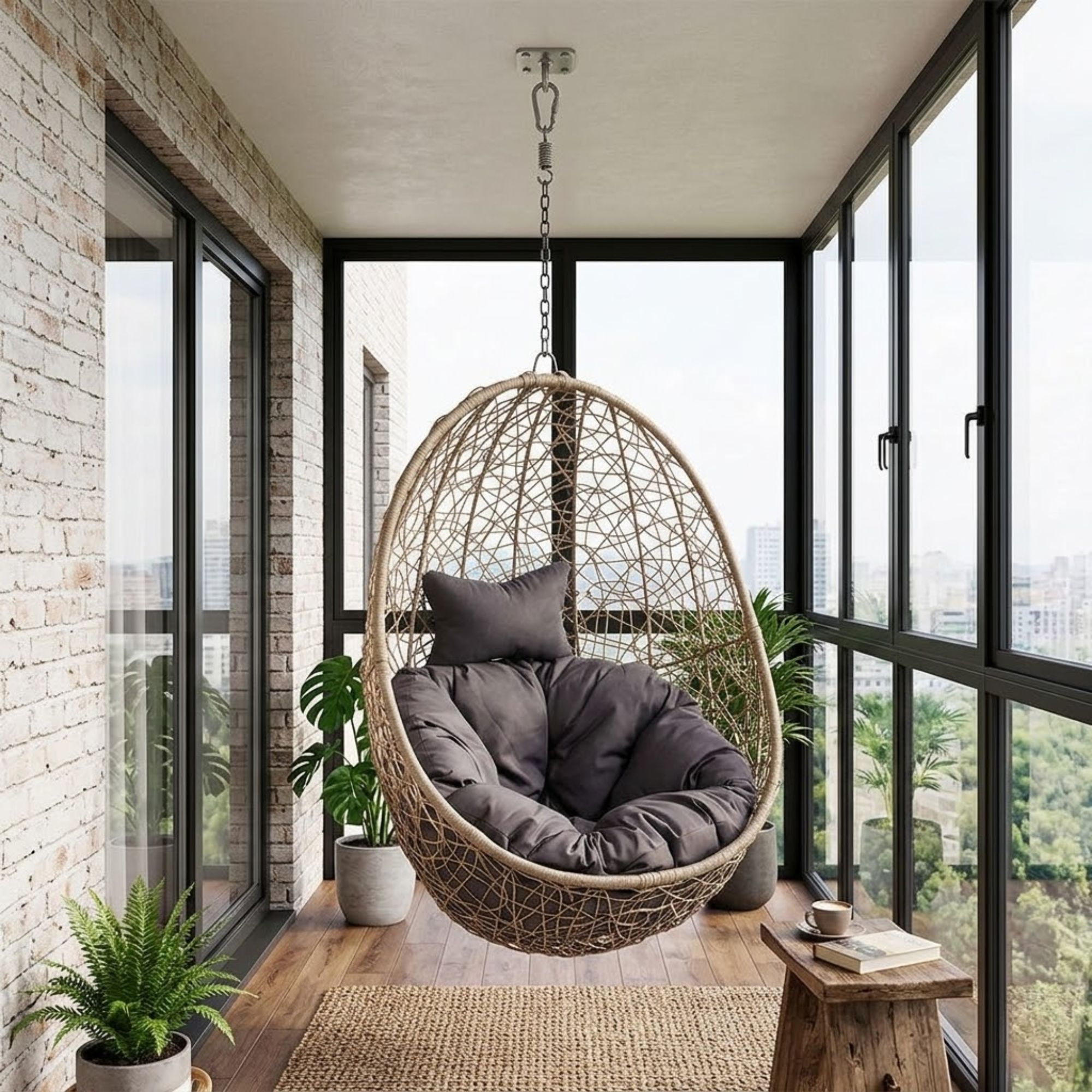
On the other hand, a chair suspended from the ceiling is a much more "space-saving" solution. The lack of a base means that the floor remains largely free, which significantly improves the functionality of the balcony. You can easily place pots, plant boxes, or even a small table under it. Such a model also gives more freedom of movement.
However, it requires proper preparation, as it is necessary to check the load-bearing capacity of the ceiling and use professional mountings. In some cases, consent from the building administration will also be required.
If your priority is to maximize the use of available space, it is worth choosing visually light suspended models, especially those with an openwork structure or made of rope. Thanks to them, the balcony will not only remain functional but will also gain a light, modern character.
A long and narrow balcony space requires conscious planning. Here, accidental furniture placement can very quickly lead to a "cluttered" effect and a loss of functionality. Fortunately, there are several proven solutions that allow you to optically enlarge the space while maintaining its practical character.
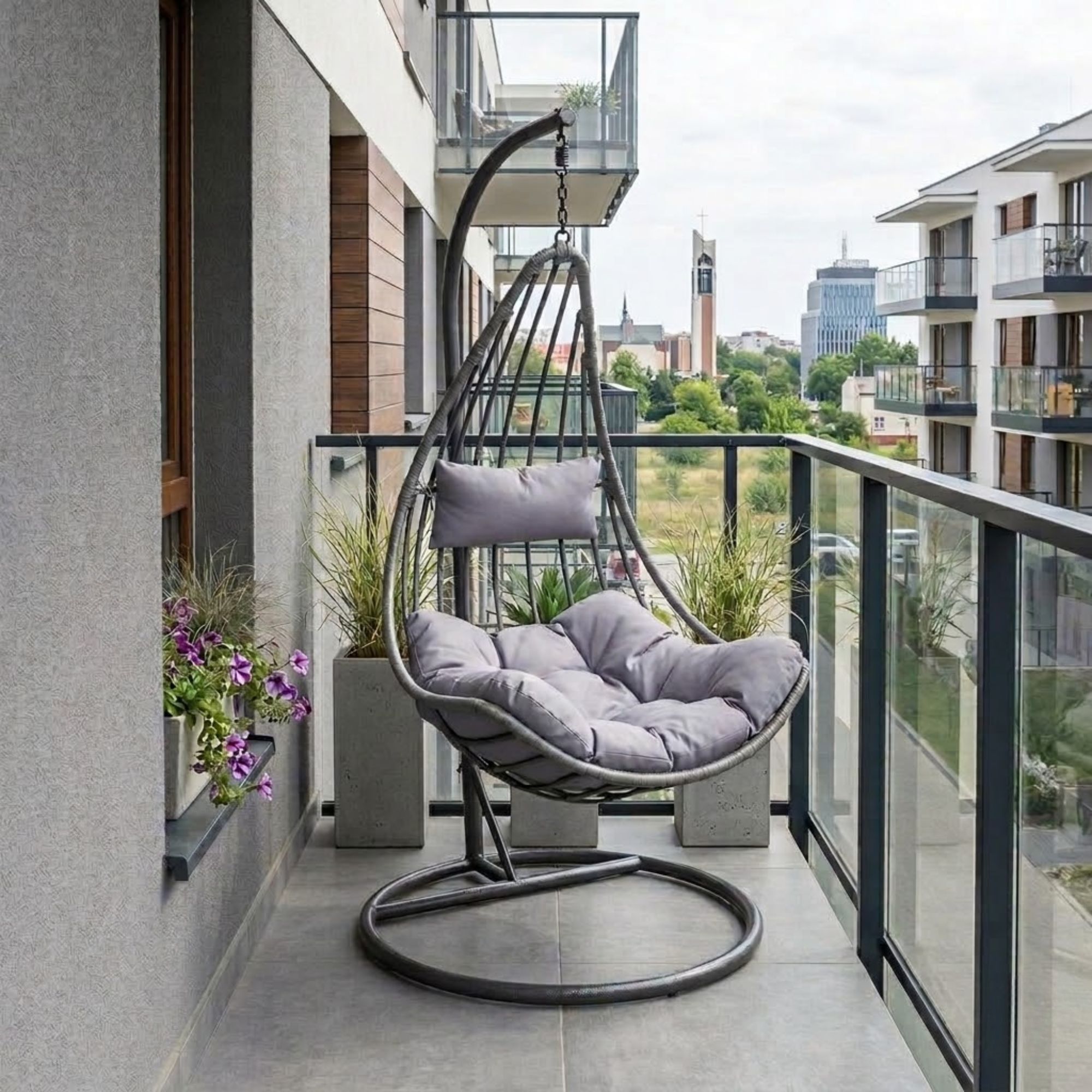
Diagonal placement is one of the most effective tricks in arranging narrow balconies. By placing the frame in the corner and directing the basket slightly towards the center, you gain a natural communication path along one of the walls. Thanks to this, the space is not "cut" by the furniture, and the passage remains comfortable and intuitive. Additionally, such a setup makes the chair look lighter and more dynamic.
Using the shorter wall is another way to optimally manage the space. If the balcony ends with a solid wall instead of a railing, it is worth treating this place as a natural "relaxation zone". Placing the cocoon there allows you to keep as much space as possible in the middle of the balcony, while creating a cozy, slightly separated relaxation corner.
Openwork constructions are of great importance in the visual perception of the entire arrangement. Models made of light, translucent weaves, especially technorattan or cord, do not dominate the space and do not overwhelm it optically. In contrast to solid, massive forms, they allow for a sense of lightness and "breath", which is crucial on a small balcony.
It is worth emphasizing that modern technorattan is a material that is not only aesthetic but also very practical. It is resistant to UV radiation, does not fade under the influence of the sun, and tolerates rain and changing temperatures well. Importantly, it does not absorb moisture, so it does not deform and does not require complicated care.
In a small space, every detail matters, especially when it comes to safety of use. The hanging chair should be positioned in such a way that it does not come into contact with the railing, wall, or glass while swinging. Even gentle impacts can lead to damage to both the furniture and the balcony itself over time.
Regular inspection of the mounting elements is an absolute necessity. It is worth checking from time to time whether all screws are properly tightened and the structure shows no signs of loosening. This applies to both frame-mounted models and suspended chairs.
Rubber pads under the base of the frame are a very practical addition. They fulfill several functions simultaneously: they protect the tiles from scratching, improve grip, and prevent the structure from sliding, which is particularly important on smooth or slightly inclined surfaces.
In well-designed models, a properly balanced center of gravity also plays a key role. It is responsible for stability during use and minimizes the risk of tilting or tipping over. Thanks to this, you can use the chair in full comfort, without worrying about safety.
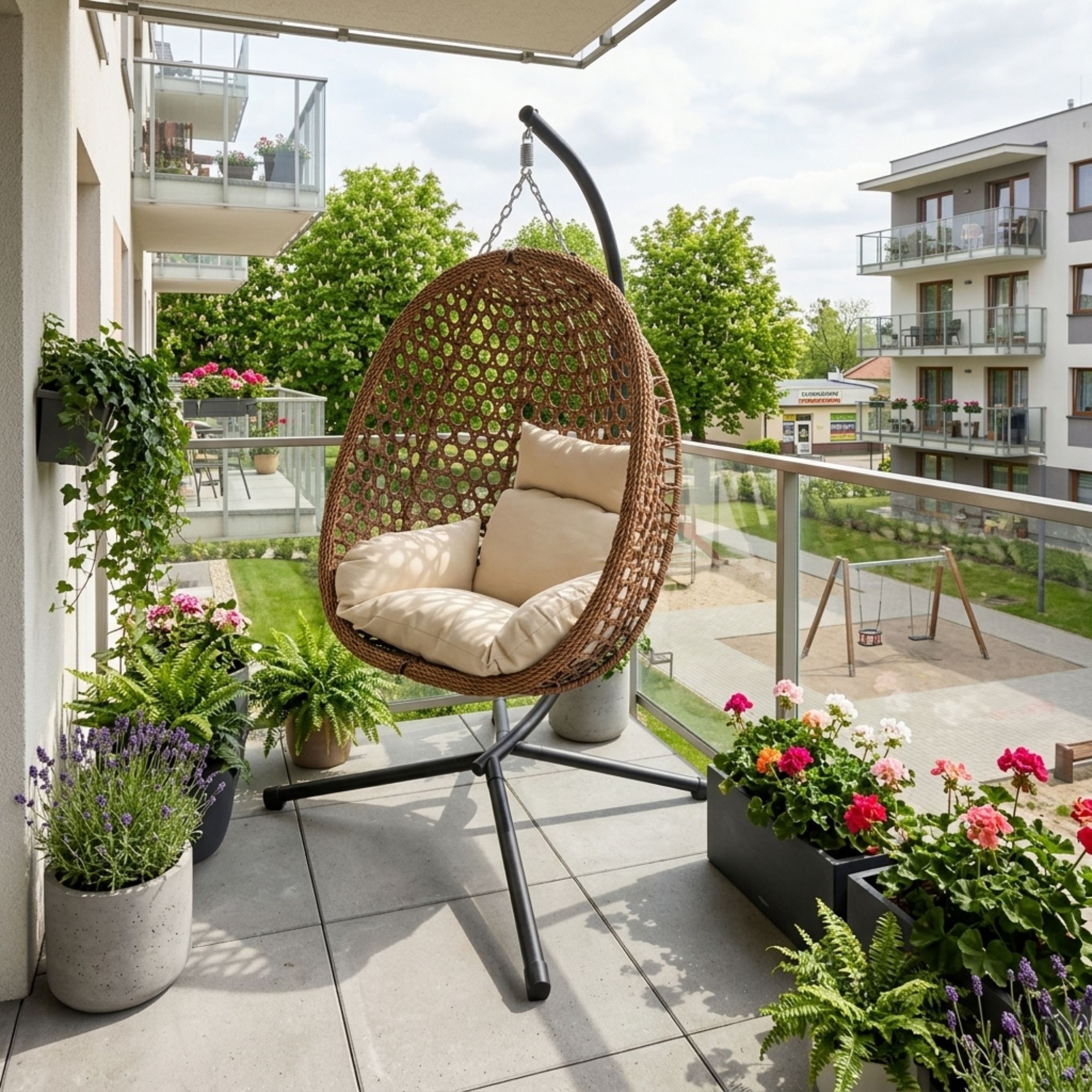
Even a very narrow balcony can gain a completely new function if it is properly arranged. The key here is matching the furniture to the available space and consciously using every centimeter.
An example of such a successful metamorphosis is a 120 cm wide balcony, where the owner decided on an armchair with a light, openwork weave. Thanks to this, the piece of furniture does not visually overwhelm the space and blends well with the surroundings.
The base of the frame was placed as close to the railing as possible, which allowed for a passage to be created. Large enough to move freely around the balcony while using its other functions, e.g., tending to plants or setting up additional decorations.
The entire arrangement was complemented by flower pots, which emphasize the cozy character of the space and create a coherent relaxation zone. This example clearly shows that even a very limited area does not have to mean giving up comfort; all it takes is a thoughtful choice and proper furniture placement.
How much space does a hanging chair need for comfortable use?
For comfortable relaxation, you need a minimum of 110 centimeters in width for the version with a frame or about 90 centimeters in the case of a basket suspended from the ceiling.
Is it always possible to drill into the balcony ceiling in an apartment building?
Before starting assembly work, you must check the quality and load-bearing capacity of the concrete and obtain written consent from your housing association.
Which hanging chair is optically the lightest for a narrow space?
In small spaces, string models woven in boho style and baskets with a very loose, translucent technorattan weave work best.
How to install a hanging chair on a balcony?
To safely install a hanging chair on a balcony, drill a hole in a solid concrete ceiling, insert a durable steel or chemical anchor with a hook, and suspend the seat on a thick chain, ensuring prior approval from the building administration.
Is my ceiling strong enough to hold a hanging chair?
The strength of the ceiling is considered sufficient if it is made of solid reinforced concrete with a minimum thickness of 15 centimeters, which allows for the safe installation of a steel expansion anchor capable of supporting a dynamic load exceeding 200 kilograms.